Jaipur | August 4, 2026
DLF, LIC, KEI Industries and Oberoi Realty Take Centre Stage Amid Corporate Developments
Indian equity markets are expected to witness heightened stock-specific activity on Tuesday as investors digest a fresh set of corporate earnings, government divestment plans and brokerage assessments. Shares of DLF, Life Insurance Corporation of India (LIC), KEI Industries and Oberoi Realty are likely to remain under the spotlight after each company reported significant developments that could influence near-term market sentiment.
The latest announcements come at a crucial stage of the June-quarter earnings season, where investors are increasingly looking beyond headline numbers to assess business fundamentals, future earnings visibility and management outlook. While weaker reported revenues weighed on DLF and Oberoi Realty, analysts believe the underlying demand environment for premium residential real estate remains resilient. LIC, meanwhile, witnessed sharp selling pressure after the government announced a large stake sale through an Offer for Sale (OFS), whereas KEI Industries strengthened its growth narrative with another quarter of robust earnings and margin expansion.
Although the four companies belong to different sectors, the market reaction highlights a common theme—investors are rewarding businesses with visible earnings growth and penalising short-term uncertainty, even when long-term fundamentals remain largely unchanged.
DLF Falls Despite Positive Brokerage Outlook
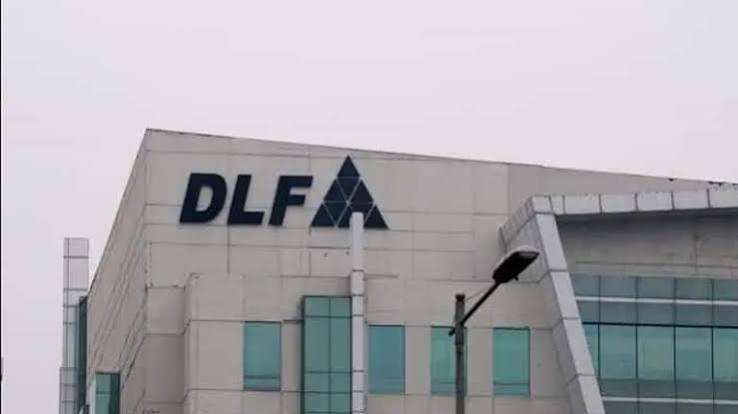
Shares of DLF declined around 2% after the country's largest listed real estate developer reported a 53% year-on-year decline in revenue for the first quarter of FY27.
The weaker top-line performance was primarily attributed to lower revenue recognition during the quarter rather than slowing demand. Revenue recognition in the real estate industry depends on project completion milestones, meaning quarterly reported revenue may fluctuate despite healthy sales bookings.
The company's earnings initially disappointed investors, leading to selling pressure during the trading session. However, analysts were quick to point out that operational indicators remain significantly stronger than the reported revenue suggests.
Global brokerage Nomura reiterated its 'Buy' rating on DLF, citing the company's strong residential pre-sales, robust launch pipeline, healthy operating cash flows and sustained demand in India's premium housing market.
Analysts noted that DLF continues to maintain one of the strongest balance sheets in the sector, giving it sufficient financial flexibility to launch new projects while generating healthy cash flows. The brokerage believes revenue growth should normalise as ongoing projects reach key construction milestones over the coming quarters.
For long-term investors, brokerages argue that pre-sales and cash generation remain more reliable indicators than quarterly revenue recognition.
LIC Slides After Government Announces ₹31,000-Crore OFS
Life Insurance Corporation of India emerged among the biggest laggards after the Government of India launched an Offer for Sale aimed at increasing the insurer's public shareholding.
LIC shares declined nearly 7% to ₹398.50 after the government fixed the OFS floor price at ₹382 per share, representing an approximate 11% discount to the previous closing price.
The OFS comprises a 2.5% base offer along with a 4% greenshoe option, potentially reducing the government's stake in LIC from 96.5% to 90%.
If fully subscribed, the issue could mobilise approximately ₹31,000 crore, making it one of the largest government disinvestment transactions in recent years.
The divestment is primarily intended to help LIC comply with the Securities and Exchange Board of India (SEBI)'s minimum public shareholding requirements applicable to listed companies.
Market participants attributed Tuesday's decline largely to the discounted pricing of the OFS rather than any deterioration in LIC's operating performance.
Several analysts believe the transaction could improve liquidity in the stock over the longer term by increasing the public float, although near-term price volatility may continue until the OFS process is completed.
KEI Industries Delivers Another Quarter of Strong Growth
Among the companies in focus, KEI Industries stood out after reporting another quarter of healthy earnings growth driven by strong operational execution.
The cables and wires manufacturer reported a 40.1% year-on-year increase in net profit to ₹274 crore, while revenue from operations rose 23% to ₹3,185 crore during the June quarter.
Operational performance remained particularly impressive.
EBITDA increased 53.4% year-on-year to ₹396 crore, while EBITDA margin expanded to 12%, reflecting improved operating leverage, better product mix and efficient cost management.
The company's consistent earnings growth reinforces investor confidence in the broader infrastructure and capital expenditure theme, where demand for electrical equipment continues to remain healthy.
KEI Industries closed at ₹5,010, approximately 12.18% below its 52-week high, with a market capitalisation of nearly ₹47,896 crore.
Brokerages continue to remain optimistic on the company, citing sustained demand from infrastructure, power transmission, real estate, industrial manufacturing and renewable energy projects.
Oberoi Realty Under Pressure Despite Strong Long-Term Fundamentals
Shares of Oberoi Realty declined 2.05% to ₹1,823, even though the company's broader financial performance continues to reflect strength in the luxury residential segment.
For FY26, the company reported revenue of ₹6,009.06 crore and net profit of ₹2,490.66 crore, highlighting its healthy long-term earnings trajectory.
However, the June quarter witnessed sequential moderation.
Revenue for Q1 FY27 stood at ₹1,300.89 crore, while net profit came in at ₹539.39 crore, leading to some profit booking in the stock.
Alongside its quarterly results, Oberoi Realty also announced a development agreement for a premium residential project in Malabar Hill, Mumbai, one of India's most sought-after luxury housing markets.
The announcement reinforces the company's strategy of expanding its presence in high-value micro-markets where demand for premium housing remains resilient despite broader macroeconomic uncertainty.
Analysts believe project execution, future launches and sustained demand in Mumbai's luxury residential market will remain the key drivers of earnings over the medium term.
Read aslo : RBI Policy, Q1 Earnings and West Asia Developments to Drive Indian Markets This Week
Market Perspective
Tuesday's stock-specific developments underline the increasingly selective nature of the market.
While headline earnings continue to influence short-term price movements, investors are placing greater emphasis on management guidance, project pipelines, balance-sheet strength and long-term earnings visibility.
DLF and Oberoi Realty demonstrate how quarterly revenue volatility does not necessarily indicate weakening business fundamentals, particularly in the real estate sector where revenue recognition depends on construction milestones.
LIC's decline reflects the impact of supply-related concerns arising from the government's discounted stake sale, whereas KEI Industries continues to benefit from India's structural infrastructure growth story and improving industrial demand.
As the earnings season enters its final phase, institutional investors are expected to focus increasingly on cash flows, future order books, capital allocation and demand outlook rather than headline quarterly numbers alone.
Aurelius Business View
The latest developments across DLF, LIC, KEI Industries and Oberoi Realty highlight that market reactions often diverge from long-term business fundamentals. While discounted government stake sales and quarterly revenue recognition can trigger immediate volatility, institutional investors generally focus on cash flows, execution capability, balance-sheet strength and future earnings visibility. Companies with robust project pipelines, consistent profitability and disciplined capital allocation are typically better positioned to create sustainable shareholder value over the long term. Investors should distinguish between short-term market noise and structural business trends before making investment decisions.
Disclaimer
Disclaimer: This article is published solely for informational purposes and should not be considered as investment advice, an offer to buy or sell securities, or a recommendation regarding any financial product. Financial markets are subject to risks, and past performance is not indicative of future results. Readers are advised to conduct their own research or consult a SEBI-registered investment advisor or qualified financial professional before making any investment decisions. Aurelius Business does not accept any responsibility for financial losses arising from the use of information contained in this article.