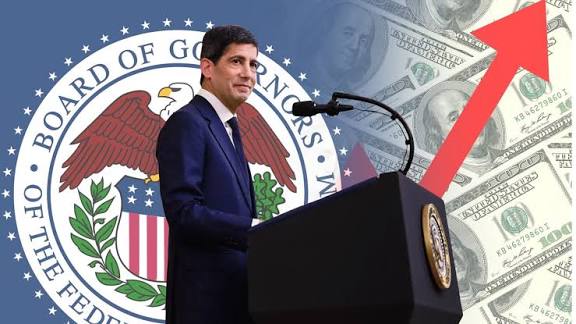
Wall Street sells off after Warsh delivers hawkish message alongside first hike since 2023
JAIPUR:The U.S. Federal Reserve broke a three-year streak of standing pat on interest rates this week, lifting its benchmark rate by a quarter of a percentage point and setting off a wave of selling across global equity markets that had, until the announcement, been drifting higher.
The Decision
The Federal Open Market Committee voted unanimously on Wednesday to raise the federal funds target range to 3.75%–4.00% from 3.50%–3.75%, marking the central bank's first rate increase since July 2023, when the Fed concluded its post-pandemic tightening campaign under then-Chair Jerome Powell. The move, widely expected by markets heading into the meeting, was driven by inflation readings that have stayed stubbornly above the Fed's 2% target even as broader economic growth has held up.
Fed Chair Kevin Warsh, in his post-meeting statement, framed the hike as necessary to keep price pressures from becoming entrenched, according to reporting from Reuters carried by Yahoo Finance. The Fed's updated quarterly projections — the so-called dot plot — showed most policymakers now expect at least one more rate increase before the end of the year, a signal that caught investors off guard given how brief and terse the central bank's public messaging has been under Warsh.
Markets React
Equity markets initially shrugged off the rate decision itself, having largely priced in the move. The turbulence began once Warsh took questions from reporters. CNBC reported that the Dow Jones Industrial Average tumbled 631 points, or about 1.2%, while the S&P 500 slipped roughly 0.4–0.5% and the Nasdaq Composite finished essentially flat after giving back earlier gains.
CNN Business noted that the sell-off deepened as long-dated Treasury yields and the U.S. dollar both climbed, with the 10-year Treasury yield holding near the psychologically significant 5% level — a mark it had touched for the first time since 2007 in the run-up to the meeting, per CNBC's coverage. Financial stocks led the market's retreat, with Goldman Sachs among the session's biggest laggards after its chief executive flagged rising costs at an investor conference the same day.
Fortune's markets desk described the pattern as familiar: stocks had rallied into the announcement, only to reverse hard once Warsh began speaking, a repeat of investor reaction to the Fed's July press conference. Analysts at Evercore ISI, cited by CNBC, characterized Warsh's tone as disciplined and hawkish rather than alarmist, but said his emphasis on persistent inflation left little room for markets to expect near-term relief.
Global Ripple Effects
The impact was not confined to Wall Street. Asian and European bourses, which had opened the week on a cautiously optimistic note, came under pressure as the dollar's rally made dollar-denominated debt more expensive for emerging-market borrowers and squeezed currencies across the developing world. A stronger greenback also weighed on commodity prices, with gold and industrial metals slipping as traders recalibrated expectations for how long U.S. borrowing costs will stay elevated.
Bond markets bore some of the sharpest moves. The 2-year Treasury yield, which tracks near-term rate expectations most closely, jumped more than seven basis points as traders priced in a real chance of another hike before year-end. Mortgage rates and other consumer borrowing costs are also expected to tick higher in the coming weeks, adding to affordability pressures that have already weighed on housing activity through much of 2026.
Sector Winners and Losers
Financials were the standout losers, with major banks including Goldman Sachs sliding as investors weighed tighter financial conditions squeezing lending margins and deal activity. Rate-sensitive sectors such as real estate and utilities also came under pressure, since higher yields make their dividend payouts comparatively less attractive. Small-cap stocks underperformed large caps — a pattern strategists at Mackenzie Investments told Reuters they expect to continue if conditions keep tightening. Not every corner moved lower, though: the tech-heavy Nasdaq's modest decline reflected resilience among mega-cap names seen as less exposed to near-term rate swings.
The Warsh Factor
A recurring theme in Wednesday's market reaction was investors' evolving relationship with Warsh himself, who has led the Fed through a series of unusually brief public communications since taking over as chair. CNBC's analysis noted that Wednesday's post-meeting statement ran to just 130 words — shorter even than July's already terse release — and that Warsh fielded reporters' questions for only around 22 minutes. That brevity has left investors parsing every word for clues about the path ahead, arguably amplifying market swings that might otherwise have been more muted.
Why It Matters
The hike ends what had become an unusually long stretch of rate stability. The Fed had cut rates by a cumulative 1.75 percentage points between September 2024 and late 2025 before holding steady through the first half of 2026, according to Kitco's Reuters wire coverage of the run-up to this decision. Wednesday's reversal suggests the central bank now views inflation — driven in part by rising energy costs — as enough of a threat to resume tightening even at some risk to growth.
The decision also lands amid unusually public friction with the White House. President Trump renewed his call for lower borrowing costs on social media within hours of the announcement, a stance he has repeated frequently in recent months, per CNN's live coverage. Warsh declined to comment directly on the political pressure during his press conference, reiterating the Fed's institutional independence from the administration.
For investors, the immediate takeaway is that the era of cheap, predictable Fed policy has given way to renewed uncertainty. With policymakers themselves split on how much further rates might rise this year, strategists quoted by Reuters expect increased volatility in both equities and fixed income in the weeks ahead, particularly as markets weigh the odds of another hike at the Fed's next meeting.
Sources: CNBC, CNN Business, Reuters (via Yahoo Finance)