Jaipur | Aurelius Business
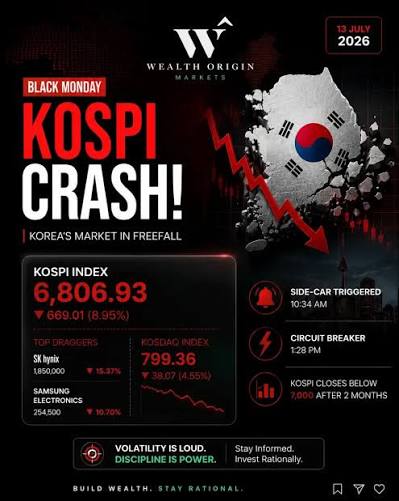
South Korea's benchmark KOSPI index plunged as much as 9-10% on Tuesday, triggering circuit-breaker style trading halts, as a deepening global selloff in semiconductor stocks rattled investors across Asia. The rout marks one of the sharpest single-day declines for the Korean market this year and has reignited concerns over whether the artificial intelligence infrastructure boom can sustain its current spending trajectory.
Chipmakers Bear the Brunt
The selloff was led by South Korea's two chip heavyweights — Samsung Electronics and SK Hynix — both of which suffered steep intraday losses, with SK Hynix falling as much as 13% at one point. The KOSPI, often viewed as a bellwether for global AI-related investment sentiment, tumbled to its lowest level since April.
The damage was not confined to Korea. Japan's Nikkei 225 dropped nearly 4-4.5%, Taiwan's Taiex fell close to 3.8%, and Japanese chip-equipment names such as Tokyo Electron and Kioxia saw double-digit declines. The broader MSCI Asia Pacific index slipped around 3%, reflecting how deeply the AI infrastructure trade has become embedded across regional markets.
China's CXMT Debut Rattles Competitive Landscape
A key trigger behind the selloff was the blockbuster stock market debut of Chinese memory chipmaker ChangXin Memory Technologies (CXMT) on Shanghai's tech-focused STAR exchange. CXMT shares surged as much as 466% on listing day, after the company raised over $8.6 billion in its IPO. Market analysts noted that investor anxiety centres less on CXMT's current earnings and more on its potential to rapidly scale capacity and challenge established Korean and Japanese chipmakers, alongside reports that China has begun domestic production of advanced immersion deep-ultraviolet lithography equipment — technology previously dominated by a handful of global suppliers.
AI Spending Sustainability in Question
Beyond the China competition angle, the broader selloff reflects mounting investor scrutiny of whether the enormous capital expenditure being funnelled into AI infrastructure — data centres, high-bandwidth memory, and advanced chip fabrication — can generate returns proportionate to the scale of investment. This questioning mood has been building for weeks across global tech and semiconductor stocks and appears to have reached a tipping point in Tuesday's session.
India Stays Relatively Insulated
Domestic equity benchmarks opened on a cautious note tracking the weak Asian cues, but showed notable resilience through the session. The Sensex and Nifty 50 remained broadly stable, even edging higher during the day, in contrast to the sharp losses across East Asian markets. Nifty IT stocks bucked the regional trend, surging around 2% in early trade, while energy and PSU banking counters lagged. Crude oil prices also slipped over 1%, easing input-cost pressure for Indian industry.
Aurelius Business View
Tuesday's rout is a reminder that the AI trade, for all its momentum over the past two years, remains vulnerable to sharp repricing the moment competitive or valuation assumptions are challenged. CXMT's explosive debut is less about one company's fundamentals and more a signal that China's chip self-sufficiency push is advancing faster than many global investors had priced in — and that changes the competitive calculus for Korean and Japanese suppliers who have been prime beneficiaries of the AI capex cycle.
For Indian markets, the relative resilience shown by the Sensex and Nifty is encouraging, but it should not be read as full insulation. Indian IT services firms have limited direct semiconductor exposure, which explains today's outperformance, but any prolonged unwind in global AI infrastructure spending would eventually filter through to export demand, FII flows, and sentiment across the broader technology ecosystem. Investors would do well to track whether this remains a one-day risk-off event centred on Korea and Japan, or the start of a broader reassessment of AI-linked valuations globally.
Disclaimer: This article is for informational purposes only and should not be construed as investment advice. Readers are advised to consult a qualified financial advisor before making any investment decisions. Aurelius Business does not take responsibility for any losses incurred based on the information provided.