Sales Strong, Profits Under Pressure: Energy Emerges as the Biggest Drag in Q1FY27, While Smallcaps Show the Momentum
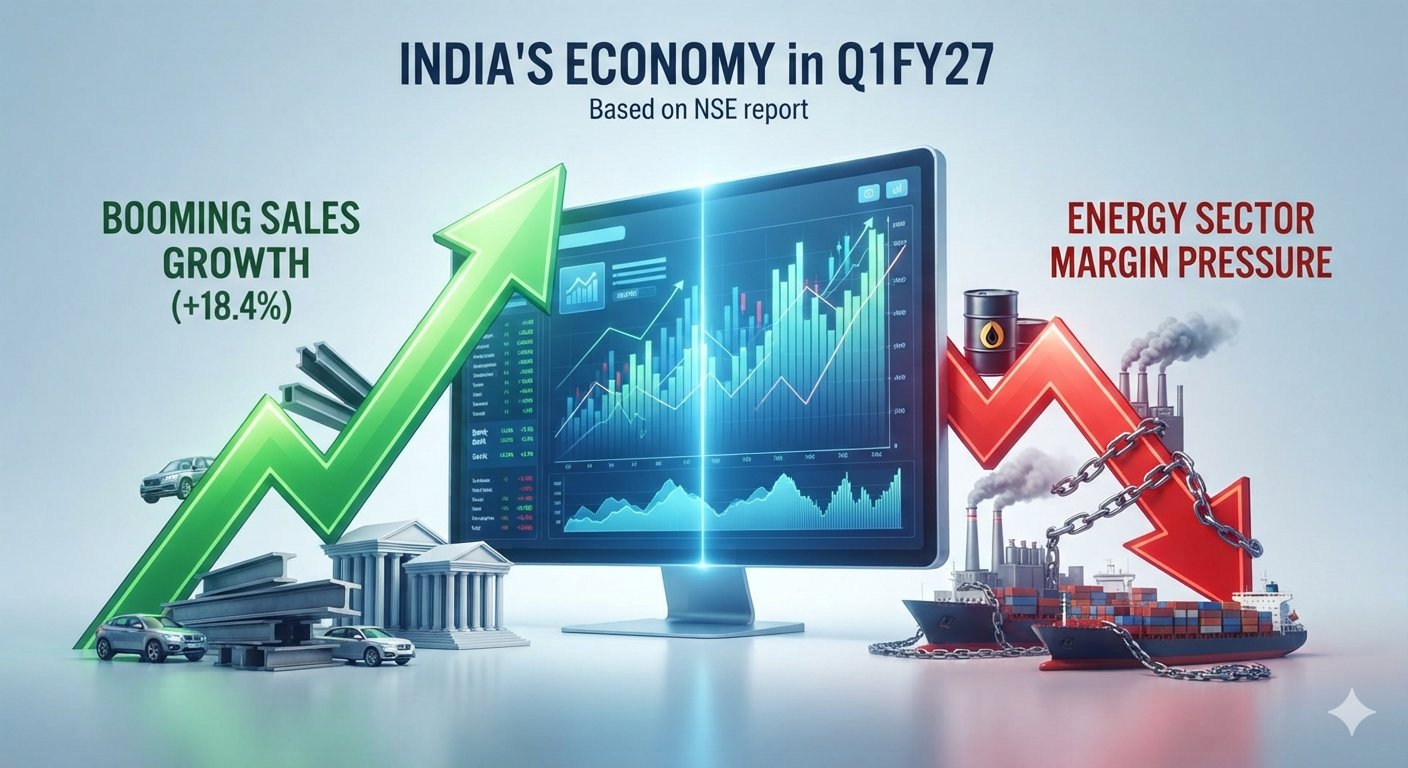
The first-quarter results for FY2026-27 painted a mixed picture for Indian companies. According to the NSE's Corporate Performance Review report, sales (the top line) remained strong, but high crude oil prices and rising costs slowed the pace of profit growth (the bottom line). Tensions in West Asia, shipping costs and global uncertainty visibly weighed on margins.
The report goes beyond profit figures. It also sheds light on how profits are distributed, how analysts are feeling and what the growth outlook looks like. Let's look at each in detail.
1. Wider Profit Base: PAT-HHI at Its Lowest in Years
The report's most interesting data point relates to the Herfindahl-Hirschman Index (HHI), which shows how widely total profit is spread across companies. The Nifty 500 PAT-HHI fell to 147, its lowest level since June 2011.
The lower the index, the more companies share the profit pool. In other words, a large share of earnings is no longer concentrated in a handful of giants, and mid-cap and small-cap companies are increasing their share. This is generally seen as positive for market stability, since dependence on any single sector or company declines.
2. Analyst Sentiment: ERI Close to Zero
The Earnings Revision Indicator (ERI) measures changes in analysts' estimates. According to the report, it has improved to near zero, meaning upgrades and downgrades are roughly balanced.
Last year, amid recession fears, most estimates were being cut. That phase of downgrades now appears to be easing. However, it does not yet mark the start of a full upgrade cycle. The market is currently in a state of balance.
3. FY27 Estimate Cut, but Medium-Term Outlook Remains Strong
Due to pressure in the energy sector, the FY27 growth estimate has been trimmed to 9.2%. Even so, the projected FY26-28 compound annual growth rate (CAGR) for the top 200 companies stands at 17.2%. This suggests the current pressure is largely viewed as short-term.
Sector Report Card
Financials: Supported by credit growth of around 20% in retail and corporate loans and better asset quality, the sector was the main driver of overall earnings. On the other hand, slower deposit growth had a mild impact on net interest margins (NIM).
Materials: Government capital expenditure (capex) and infrastructure activity kept demand for cement and metals strong, lifting the sector's EBITDA by 25.6%. However, input and production costs rose in some pockets.
Energy: This sector was the biggest paradox. Higher crude prices from the West Asia conflict pushed nominal revenue up 32.2%. But shrinking refining and marketing margins caused EBITDA to fall 37.4%. This sector weighed the most on overall market profits.
IT: Rupee weakness against the dollar provided a currency translation benefit. However, global IT budgets and fresh spending by large corporations remained sluggish, which is a concern for future growth.
Telecom (Communication Services): Higher average revenue per user (ARPU) and new subscriber additions pushed net profit up 127.1%, one of the sharpest gains of the quarter.
Smallcaps Drive the Profit Engine
While large and mid-cap companies faced margin pressure, Nifty Smallcap 250 companies recorded a 33.9% year-on-year rise in net profit (PAT). Smallcap companies alone contributed roughly one-fourth (25%) of the total profit growth of Nifty 500 companies. This is consistent with the low HHI picture, indicating that the earnings base is genuinely broadening.
What It Means for Investors
The report's data points to a few takeaways:
- Domestic demand and the investment cycle remain strong. Margin pressure is mostly due to global factors such as crude oil, shipping costs and geopolitical tensions.
- The energy sector's performance will be key in shaping overall market earnings in the coming quarters.
- A stock-specific approach may work better from here. Companies that manage input costs efficiently, such as financials, telecom and capex-linked materials, are considered better placed.
- Smallcap growth is attractive, but the segment is also more volatile, so caution is needed in stock selection.
Overall, the Q1FY27 results show that the foundation of Indian corporate earnings is strong, but global shocks continue to weigh on margins. The road ahead will depend largely on crude oil prices and global conditions. Source: National Stock Exchange (NSE) Corporate Performance Review Report, Q1FY27
(Disclaimer: This article is for informational purposes only and does not constitute investment advice. Please consult your financial advisor before investing.)