
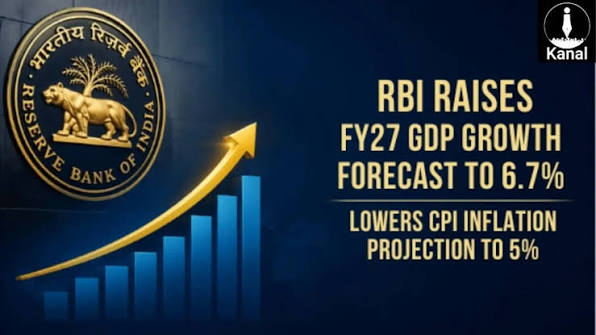
Jaipur, August 8, 2026 -- The Reserve Bank of India's decision to keep its policy repo rate unchanged at 5.25% reflects confidence in India's economic resilience, with the central bank raising its GDP growth forecasts and lowering its inflation expectations. The move removes uncertainty that has haunted markets since the rupee's slide to 97 per dollar and the resulting $17.3 billion in foreign portfolio outflows year-to-date.
Market participants reading between the lines found the real message not in the rate decision itself, but in the RBI's forward guidance: inflation is cooling, growth is strengthening, and policy stability matters more than emergency interventions. For stock market investors, this sets up a different game entirely than the defensive posture required during the rupee crisis.
Key Facts
-
RBI maintained the repo rate at 5.25%, the decision announced during the August 2-8 monetary policy review. This marks the central bank's holding pattern after a series of rate hikes last year aimed at controlling inflation that had breached comfort levels.
-
GDP growth forecast was upgraded, signaling that the RBI now sees the Indian economy expanding faster than previous estimates despite global headwinds and domestic capital outflow pressures. The upgrade reflects confidence in domestic demand resilience and government spending momentum.
-
Inflation outlook was lowered, indicating that price pressures have moderated below the central bank's 4% target. This breathing room removes the urgency for further rate hikes and opens the door to potential rate cuts in the fourth quarter of 2026 or early 2027.
-
Markets welcomed the announcement and equity indices rallied on the stable rate message. Investors saw the decision as a sign that the worst of the external pressures -- rupee weakness, capital outflows -- may be over.
-
The rate hold removes policy uncertainty, giving businesses certainty about the cost of borrowing. This predictability has historically supported corporate investment, capex spending and consumer demand, the drivers of cyclical stock performance.
-
Forward rate cut expectations are now priced in, with traders and analysts expecting the RBI to begin a cutting cycle by October 2026 or later, should inflation continue its downward trajectory. This prospect reshapes the investment narrative away from defensive positioning.
Aurelius Business View
Why This Matters More Than the FCNR Story: The rupee crisis demanded a tactical response—FCNR deposits, forex intervention, emergency measures. Those are necessary but temporary. The RBI's growth upgrade and rate hold, by contrast, signal strategic confidence. The central bank is essentially saying: "We believe in India's medium-term growth trajectory. Stable rates will support investment. Inflation is under control."
Investors scarred by rupee volatility and FPI selling should recognize the significance. When a central bank holds rates while upgrading growth, it's betting the domestic economy is strong enough to weather external shocks. That's exactly the sentiment needed to reverse capital outflows.
The FPI Narrative Turns: Over the past eight months, foreign investors have yanked $17.3 billion from Indian equities. That selling was driven by three fears: (1) a weak rupee, (2) rising inflation and potential rate hikes, and (3) slowing growth. The RBI's decision addresses all three. Stable rates ease the rate hike fear. Lowered inflation removes the first concern. Growth upgrade tackles the third. Not all at once—but enough to shift sentiment from "India is a problem" to "India's troubles may be priced in."
Sector Rotation Begins: With the rupee having already fallen 5%+ year-to-date and export stocks having rallied on forex tailwinds, the RBI rate hold opens a new phase. Cyclical stocks—banks, autos, infrastructure, discretionary—begin to attract flows as investors rotate from defensive export plays toward domestic growth beneficiaries. Why? Because stable rates and growth upgrades benefit domestic consumption and capex cycles more than export-linked companies.
The Cutting Cycle is Coming: If inflation stays on the downward path and growth holds, the RBI will cut rates by late 2026 or early 2027. This creates a two-stage play: (1) immediate relief rally in cyclicals on rate hold signals, and (2) a sustained rally once cutting actually begins. Banks particularly benefit because rate cuts widen net interest margins (the difference between lending and deposit rates) over time.
Don't Confuse Stability with Weakness: Some traders might read a rate hold as "no action." That's wrong. In a global environment where US rates remain elevated and capital is scarce, an emerging market central bank choosing to hold steady rates while others are still hiking is a statement of strength. It means India's economy doesn't need emergency monetary stimulus. That's bullish, not bearish.
What This Means for Stock Market Investors
For swing traders:
-
Cyclical stocks (auto, banks, infrastructure, real estate) are positioned for outperformance as FPI rotates back into the market.
-
Look for Nifty Auto Index and Bank Nifty to extend gains on positive earnings revisions and improved sentiment.
-
The rupee having already depreciated 5% removes the "falling knife" risk—export stocks' rally is likely maturing; take profits on momentum plays in IT and pharma.
-
Watch for FPI buying accelerations as real money (not panic-driven selling) re-enters Indian markets.
For portfolio holders:
-
A rate hold with growth upgrade typically leads to multiple expansion. Quality midcap cyclicals, which have been beaten down, offer value.
-
Bank stocks, despite yielding pressure from deposit costs (FCNR drain), should recover as rate cut expectations become concrete.
-
Auto and infrastructure stocks, sensitive to credit availability and capex cycles, stand to benefit from stable rates and improved growth visibility.
-
Maintain positions in export plays but reduce concentration—the unidirectional rupee weakness tailwind may be ending.
The Broader Picture: The RBI's August decision represents a pivot from crisis management to growth promotion. The rupee has stabilized, capital outflows are moderating (FCNR deposits arriving), and now policy can focus on supporting economic expansion. For traders, this means the rotation from export defensives to domestic cyclicals is just beginning. For long-term holders, it suggests the worst of the external pressures are behind us, and a renewed earnings growth cycle is taking shape.
Investment Disclaimer
This article is for educational purposes and does not constitute investment advice. The information provided is based on publicly available data as of August 8, 2026, and is subject to change. Investors should consult a financial advisor before making investment decisions. Aurelius Business does not guarantee the accuracy or completeness of external data and recommends independent verification of all claims.