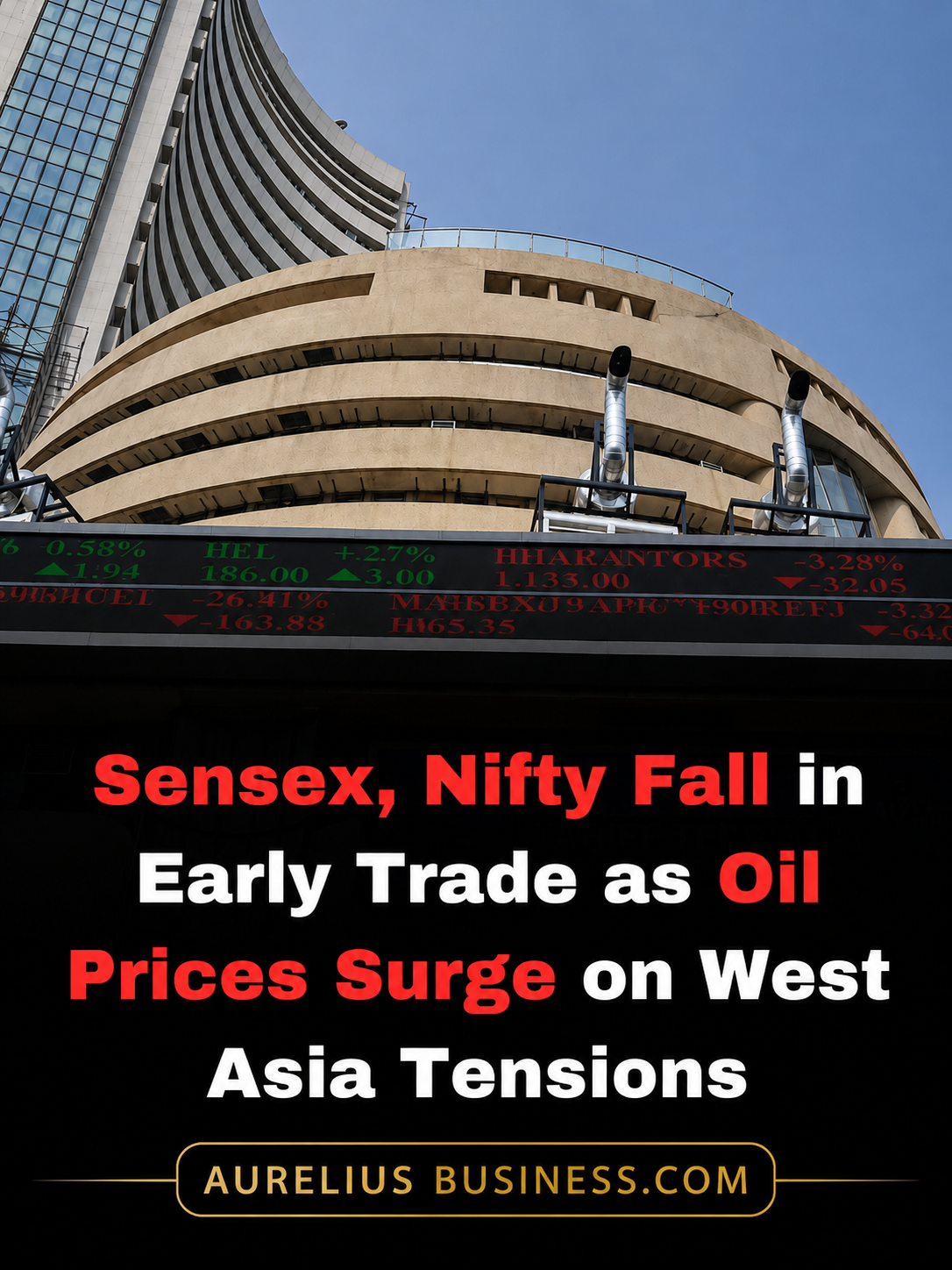
Jaipur: What unfolded on Dalal Street this week has left investors uneasy. On Friday, the market closed lower for the fifth consecutive trading session. When markets opened in the morning, things looked even worse — the Sensex tumbled over 600 points in a single stroke, and the Nifty slipped below the 23,700 mark. However, through the course of the day, the market clawed back some of its losses, though it still ended in the red. The question on everyone's mind is: what exactly is going on, and how long will this slide continue?
A Quick Look at Yesterday and Today
The market was already under pressure on Thursday. The Nifty 50 declined 0.53 per cent to close at 23,869, slipping below the crucial 24,000 psychological mark, while the Sensex fell 0.47 per cent to settle at 76,391.
That trend carried into Friday, and then some. In early trade, the Sensex tumbled 600.36 points, or 0.79 per cent, to touch 75,791, while the Nifty dropped 168.75 points to 23,700.85. As the day progressed, some buying returned and the indices recovered from their lows. By the close, the Sensex had fallen 331.62 points, or 0.43 per cent, to settle at 76,059.77, while the Nifty — after opening 203 points lower at 23,666 — closed at 23,767 following a volatile session. For the week as a whole, the Nifty is down roughly 2.33 per cent and the Sensex nearly 2.70 per cent — so this isn't just a one-day story, it's a week-long trend.
Why Is the Market Falling?
There isn't a single reason behind this decline — four or five factors are working together to keep the pressure on.
The biggest driver is the surge in crude oil prices. Amid the ongoing conflict in West Asia, Brent crude has crossed the $100-per-barrel mark, its highest level in several weeks. India meets a large share of its energy needs through imports, so every time crude gets more expensive, it directly hits the country's import bill, the rupee, and inflation expectations. The market is reacting to precisely that risk.
The second factor is the escalating geopolitical tension in West Asia. Whenever this kind of global uncertainty rises, large investors tend to pull back from risk and start withdrawing money from equity markets.
The third reason is continued selling by Foreign Institutional Investors (FIIs). With a weakening rupee and global volatility, FIIs have been trimming their holdings in Indian equities, adding further pressure on the market.
The fourth factor is rupee weakness itself, which is really a byproduct of the first two — costlier imports and FII outflows. It becomes a self-reinforcing cycle where one problem feeds into the next.
Which Sectors Are Under the Most Pressure, and Which Ones Are Holding Up
If you're thinking the entire market went down together, that's not quite the picture. Friday's session showed a fairly divergent sector-by-sector story, and that divergence is worth understanding.
Sectors under the most pressure:
Auto was the biggest loser of the day. The Nifty Auto index was the worst-performing sector. Stocks like Mahindra & Mahindra saw profit-booking after their recent outperformance, and rising crude prices added to concerns over higher input costs and softer demand.
Metal and energy stocks also came under selling pressure. The Nifty Metal index declined on the back of weak global risk sentiment and growth concerns. The Energy index fell as crude crossed $100 a barrel — while pricier oil can benefit some upstream producers, it squeezes margins for oil-marketing companies.
Realty stocks stayed under pressure too, given the sector's higher sensitivity to interest-rate expectations. Oil & gas, pharma, and infrastructure indices also saw mild weakness.
Sectors that held up, or even gained:
Media was the standout performer of the day. The Nifty Media index jumped sharply — a very different story from the otherwise cautious mood across the broader market.
IT also performed well. Stocks like HCL Technologies and Wipro ended in the green, giving the index some support.
PSU Bank stocks edged higher too, and Bank Nifty closed with modest gains — a sign that the banking sector isn't facing anywhere near the pressure that auto and metal are.
This divergence across sectors really tells the bigger story: the market is currently in "stock-specific" mode. Investors aren't selling indiscriminately — they're rotating out of sectors most sensitive to crude oil and interest rates, and staying invested in sectors where earnings growth still looks solid.
Aurelius Business View
In our assessment, this decline looks less like panic and more like a rational repricing. When crude oil crosses $100 a barrel and tensions rise in West Asia, it's natural for markets to turn cautious — that's not unusual. What's worth noting is the sector rotation: money is moving out of cyclical, crude-sensitive sectors like auto and metal, and into relatively safer ones like IT and media. That's not a sign of a major crash — it's smart money rebalancing its portfolio.
Going forward, we believe three things are worth watching over the coming weeks — first, whether crude oil prices stabilise; second, whether tensions in West Asia ease or escalate further; and third, the direction of FII flows — whether they continue selling or return as buyers. Until there's more clarity on these fronts, volatility is likely to persist. Investors would do well to avoid knee-jerk decisions, stay focused on companies with strong fundamentals, and avoid being overexposed to crude-sensitive sectors in their portfolios.
Disclaimer: The information in this article is for general informational and educational purposes only and should not be considered investment advice. Investments in the stock market are subject to market risks. Please consult a certified financial advisor before making any investment decisions. Aurelius Business or its authors will not be held responsible for any investment losses.