Yeh raha English version, wahi content aur structure:
FPIs' "Smart Game": About ₹3 Lakh Crore Pulled From the Secondary Market, Yet Over ₹54,000 Crore Bet on IPOs
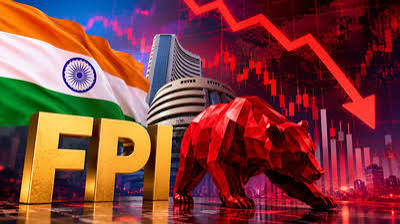
Foreign investors' moves in the Indian stock market look puzzling at first glance. In 2026, Foreign Portfolio Investors (FPIs) have withdrawn roughly ₹3 lakh crore from the secondary market, while investing more than ₹54,000 crore in new IPOs over the same period. In other words, foreign money is not fleeing India. It is changing its route: out of listed shares and into fresh listings.
What Do the Numbers Say?
This trend did not appear overnight. The pattern is clear in the last three years of data:
- 2024: FIIs invested about ₹1.21 lakh crore in the primary market, while withdrawing ₹1.28 lakh crore from the secondary market.
- 2025: Primary market investment fell to around ₹74,000 crore, while secondary market withdrawals rose to ₹2.39 lakh crore.
- 2026 (so far): Total selling through exchanges stands at about ₹2.96 lakh crore, while primary market investment is recorded at about ₹54,398 crore.
The pace of selling has also been rapid. According to NSDL data, FIIs sold shares worth around ₹1.27 lakh crore in March alone, followed by roughly ₹50,800 crore in April and about ₹54,000 crore in May. It is clear that secondary market outflows in 2026 were on track to surpass even the full-year 2025 figure.
Why Are FPIs Drawn to IPOs?
1. The valuation cushion. Many FPIs are cautious about the high prices of shares already listed on the NSE and BSE. In an IPO, they get a chance to enter at a fixed, relatively attractive price before listing.
2. Access to new sectors. Through IPOs, they are able to build positions in sectors such as electronics, consumer technology and renewable energy, which have limited weight in the main indices.
3. Large purchases without moving the market. According to Tanvi Kanchan, Associate Director at Anand Rathi Shares & Stock Brokers, the primary market offers "price certainty without market impact", meaning large sums can be deployed within a fixed price band. In the secondary market, heavy buying pushes the price up on its own, whereas in the anchor book, up to 60% of the institutional portion can be allotted.
The pace of the IPO market is also supporting this. In September 2026, 34 companies raised about ₹39,380 crore, of which more than 57% came from NSE's own IPO.
The Bitter Truth: An IPO Is an Entry Gate, Not a Permanent Home
This is the most important point for retail investors. A study by officers of SEBI's economics department analysed 242 mainboard IPOs listed between April 2022 and October 2025, of which 167 were tracked for a full year.
The rule is that shares of anchor investors remain fully locked in for 30 days after listing. Then half of the shares can be sold, while the remaining half stay locked until the 90th day. But the real story begins after the lock-in ends:
- Of the total anchor shares, sales reached 3.5% by Day 30, 18.5% by Day 90 and 50.7% by Day 365.
- By Day 365, FPIs had sold about 60% of their anchor allotment, while the figure for mutual funds was around 38%.
- In rupee terms, FPIs exited about ₹22,474 crore, while mutual funds exited ₹12,228 crore.
So selling does not happen on a single day. It continues gradually through the year. Still, the risk is visible around the first unlock. When anchors sold more than 10% of their holding, the share fell on average by about 3.5% between the 29th and 33rd trading days, with a median decline of roughly 6%. The study itself clarifies that this does not prove the fall came only from anchor selling, since market conditions and company news also have an effect.
It is sharper in smaller IPOs. In issues of ₹250 crore or less, the weighted exit by Day 365 was 72.5%, compared with 40.8% in issues of ₹1,001 to ₹2,500 crore.
Pressure on Large Caps and Risks Ahead
The effect of continuous FPI selling is visible in big companies. Shares such as HDFC Bank, Infosys and Reliance Industries, the main targets of foreign funds, have remained under pressure throughout the year. This makes it hard for benchmark indices to sustain a long rally.
There are also concerns about liquidity. It is estimated that IPOs worth ₹3.86 lakh crore could come ahead, which would keep pulling capital out of the secondary market. Global factors play a part too: US Treasury yields are high, there is tension in West Asia and crude oil prices are volatile, making global investors hesitant to take risks.
Lessons for Retail Investors
- Don't rush in chasing listing gains. If FPIs hold a large share of the anchor book, remember the possibility of selling around Day 30, Day 90 and Day 365.
- Note the lock-in calendar. The lock-in expiry dates of every IPO are known in advance. Keep an eye on the activity around them.
- Watch the holding pattern. Changes in FPI and mutual fund stakes in shareholding data are an important signal.
- Be extra careful in small issues. The data shows anchor exits are fastest there.
Conclusion
FPIs are not giving up on India's growth story, but they are also not willing to bet at expensive valuations. They enter after looking at the price and exit gradually once profits appear. The lesson for ordinary investors is simple: for any new share you want to invest in, look at what big institutional investors are doing a year later, not just what happened on listing day.
Disclaimer: This article is for informational purposes only and is not investment advice. Please consult your financial advisor before investing in any share or IPO.