Sixth Week of Losses Without a Pause
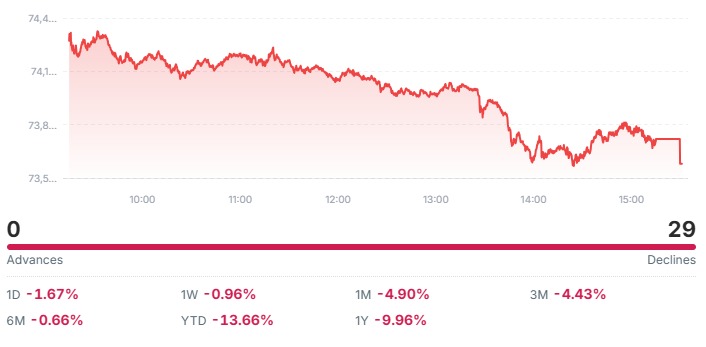
JAIPUR: It was a volatile week for the Indian stock market. Amid surging crude oil prices, rising bond yields, a weaker rupee and heightened global geopolitical tension, the Nifty posted losses for the sixth week in a row. The index ended the shortened trading week at 23,346.40, a marginal fall of 0.22% from the previous week. The decline was modest, but the market withstood considerable pressure during the week.
This analysis is based on the weekly FII-DII commentary dated 21 September 2026 by Pabitro Mukherjee, Deputy Vice President-Research at Bajaj Broking. All figures and assessments below are drawn from that report.
Sharp Selling at the Start of the Week
According to Bajaj Broking, benchmark indices faced heavy selling pressure at the start of the week. The report attributes this to Brent crude rising towards roughly $109.90 per barrel, a jump in bond yields, rupee weakness and deepening geopolitical uncertainty.
On Tuesday, the Nifty slipped to an intra-week low of 23,116. Selling pressure then eased, and the index recovered from the lows to end the week at 23,346.40, regaining some of the lost ground from Tuesday's bottom.
Bank Nifty and the Broader Market
Caution persisted in banking stocks. The Bank Nifty fell 0.44% during the week. According to the report, investors remained wary of the banking sector.
Profit booking was also visible in the broader market. The Nifty Midcap index fell 0.01% and the Smallcap index fell 0.12%. The decline in midcaps was almost negligible, while smallcaps saw slightly more pressure.
Tough Stance from Global Central Banks
Global monetary policy also weighed on sentiment. According to Bajaj Broking, the US Federal Reserve raised its policy rate by 25 basis points to 3.75%-4.00%, its first hike since 2023. The Fed also signalled that further tightening may be needed if inflation stays elevated.
Meanwhile, the Bank of Japan (BoJ) also raised its policy rate by 25 basis points to 1.25%, a 31-year high. The report attributes this to persistent inflationary pressure. The hawkish stance of both major central banks dented global investors' appetite for risk.
FIIs and DIIs: Selling Versus Buying
Foreign institutional investors (FIIs) were net sellers for the fifth consecutive week, offloading shares worth ₹7,620 crore (Rs 76.20 bn) in total. Domestic institutional investors (DIIs), by contrast, continued their buying streak with net purchases of ₹11,232 crore (Rs 112.32 bn). According to the report, this domestic buying helped the Nifty recover from its mid-week lows.
The month-to-date picture
- FII net selling so far in September: ₹7,041 crore (Rs 70.41 bn)
- DII net buying over the same period: ₹36,219 crore (Rs 362.19 bn)
- Nifty is down 3.05% from its August-end close of 24,080.40
Bajaj Broking notes that over the past month FIIs were net sellers in all five weeks, while DIIs remained net buyers every week. In that period the Nifty slid from 24,154.90 to 23,346.40. In other words, domestic buying slowed the pace of the decline, though it was not enough to push the index higher.
Key Factors Influencing the Market
Crude oil: Brent crude moving towards $109.90 per barrel remains a concern for an import-dependent economy. The report lists it among the main reasons for the selling at the start of the week.
Bond yields and the rupee: Higher yields and a weaker rupee also affected investor sentiment. The report highlights both as sources of pressure on the market.
Interest rates: The rate hikes by both the Fed and the BoJ point to tightening financial conditions globally.
Geopolitics: Amid heightened international uncertainty, the report says market participants will keep a close watch on US-Iran developments.
The Expert's Assessment
According to Pabitro Mukherjee of Bajaj Broking, sustained FII selling and global headwinds are likely to keep the market volatile in the near term. However, his assessment is that steady buying by domestic institutions should help limit the downside. This is the brokerage's view and not a guaranteed forecast.
What Will Matter for the Market Ahead?
According to Bajaj Broking's commentary, market participants will be watching the following in the coming days:
- Brent crude prices: Further moves in oil could influence inflation and rupee sentiment.
- US-Iran geopolitical developments: Any fresh news could affect global risk sentiment.
- US and domestic PMI data: These will indicate the direction of economic activity and offer cues for near-term market direction.
- FII-DII flows: The balance between foreign selling and domestic buying will be important in determining market direction.
Overall, the market is currently caught between global pressures and domestic support. Investors will be watching which way the balance between these two forces tips in the coming weeks.
(Disclaimer: This article is for informational purposes only. The views expressed belong to the respective brokerage. It is not investment advice for any stock or index. Consult a qualified advisor before investing.)
Source: Bajaj Broking, Weekly FII-DII Commentary,