
Jaipur — Despite drawing $36.72 billion in foreign currency deposits through July, India's economic appeal among foreign investors continues to erode, according to former Reserve Bank Governor Duvvuri Subbarao, who warned that short-term deposit schemes cannot compensate for the rupee's structural weakness.
The currency has tumbled to record lows near 97 per dollar as foreign investors pulled a net $17.3 billion from Indian stocks and bonds in 2026. While the RBI's June initiative to attract FCNR-B deposits has garnered substantial inflows, Subbarao cautioned that the strategy is "too costly" to justify if its only purpose is to artificially bolster confidence in the rupee. The real culprit, he argued, is India's waning competitive position versus global alternatives.
Key Facts
- FCNR-B deposits reached $36.72 billion through July 31, 2026, and bankers expect inflows to exceed $50 billion by year-end as the RBI incentivized non-resident Indians with higher interest rates to shore up forex reserves.
- Foreign portfolio investors net sold $17.3 billion from Indian stocks and bonds during the first seven months of 2026, amplifying pressure on the rupee and signaling reduced confidence among global fund managers.
- Rupee hit a record low near 97 per dollar in May 2026, marking a significant depreciation as demand for dollars outpaced inflows. The currency remains under sustained pressure despite FCNR deposit mobilization.
- Indian equities command a 44% valuation premium over the broader Asian gauge, making them relatively expensive compared to competing Asian markets and pushing global investors toward alternative destinations.
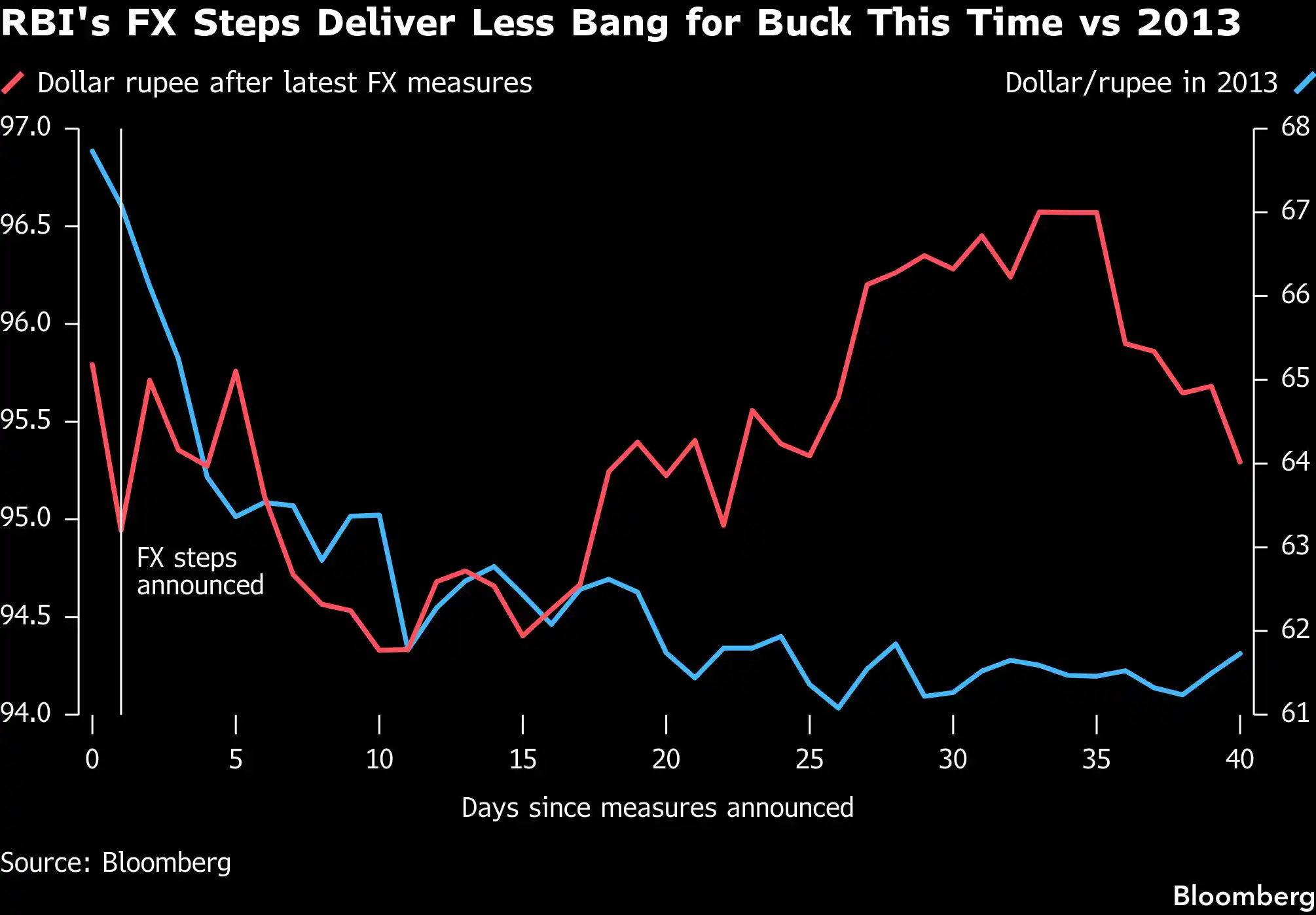
- The RBI's 2026 intervention strategy underperformed 2013 efforts, with the rupee declining 0.5% in the first 46 days following FCNR measures in 2026, compared with a 7% gain in the same period during the 2013 episode—reflecting a far weaker demand environment.
- Global AI and semiconductor investment booms are siphoning foreign capital away from India toward developed markets, while Indians themselves are accelerating overseas remittances and foreign investments, creating a two-way capital outflow dynamic.
Aurelius Business View
FCNR as a Costly Band-Aid: Duvvuri Subbarao's warning cuts to the heart of India's external vulnerability: the FCNR scheme is "too costly" when measured against its limited impact. In 2013, when the RBI deployed similar measures during another rupee crisis, global liquidity was abundant and funding costs were cheap. Attracting FCNR deposits then made economic sense. Today, with US interest rates elevated and global capital scarce, the RBI must offer premium rates to lure NRI deposits—but those deposits only move the needle by 0.5% over six weeks, compared to the 7% rupee appreciation achieved in 2013.
The Valuation Problem: At a 44% premium to Asian peers, Indian equities have priced in unrealistic growth expectations. Foreign investors who bought into India's growth story at elevated valuations are now reassessing. The outflow of $17.3 billion YTD reflects not panic selling but rational reallocation—why hold expensive Indian tech stocks when AI and semiconductor opportunities offer better risk-reward in the US, Taiwan, or Korea? No deposit scheme can reverse this calculus.
Competing for Global Capital: India isn't just competing with other markets on returns—it's competing on terms. Subbarao noted that overseas investment in AI and semiconductors is booming, and global capital gravitates toward those narratives. Simultaneously, Indians are moving money abroad at an accelerating pace, seeking better opportunities and hedging rupee risk. This two-way outflow is structural, not cyclical. Deposit schemes cannot stem a flight to quality.
Why 2013 Won't Repeat: The cost-benefit case has fundamentally shifted. In 2013, the RBI could attract FCNR deposits at reasonable spreads over global rates. In 2026, the RBI must pay premium rates, locking in forex costs that may exceed the long-term benefit. Subbarao's implicit message: if India's fundamental attractiveness to foreign capital has weakened this much, treating the symptom (rupee weakness) with expensive band-aids is misallocating precious capital. The real solutions—stronger domestic growth, lower investor friction, deeper structural reforms—take years to implement but are the only paths to durable stability.
What This Means for Stock Market Investors
For swing traders and short-term traders:
- Rupee weakness accelerating toward 97+ per dollar creates sharp sector rotation opportunities: export-heavy IT, pharma, auto components, and textiles benefit from favorable forex tailwinds.
- Import-dependent sectors (oil refining, metals, specialty manufacturing) face continued margin compression—avoid or short these on bounces.
- FPI selling waves typically coincide with rupee weakness cycles. Watch for sharp corrections in large-cap defensives on negative policy signals or earnings misses—these offer buying opportunities for long-term holders.
For portfolio holders:
- The 2026 FCNR episode mirrors 2013, but with reversed dynamics: in 2013, the rupee bounced 7% within 46 days; in 2026, it's still down 0.5%. This divergence signals that deposit schemes have lost potency—rupee weakness may persist longer than historical cycles.
- High-beta names (financials, discretionary, infrastructure) remain vulnerable to FPI withdrawal surges. Position sizing is critical.
- Quality export-linked plays (TCS, Infosys, Cipla, Dr. Reddy's, Maruti Suzuki) offer relative safety as rupee weakness drives margin expansion.
- Watch closely for signs of genuine FDI pickup or RBI policy shifts toward inflation-targeting credibility (both would attract portfolio flows and reverse the rupee).
The Broader Play: Subbarao's message is clear: FCNR deposits are a temporary cushion, not a solution. If India can rebuild FDI confidence through structural reforms and demonstrate strong domestic growth, foreign capital will return and the rupee will stabilize. Until then, expect continued rupee volatility, FPI outflows on any signs of softening momentum, and sustained premiums for export-linked equities.
Investment Disclaimer
This article is for educational purposes and does not constitute investment advice. The information provided is based on publicly available data as of August 11, 2026, and is subject to change. Investors should consult a financial advisor before making investment decisions. Aurelius Business does not guarantee the accuracy or completeness of external data and recommends independent verification of all claims.