JAIPUR: Another Adani Group company is in the news. On Wednesday, September 9, 2026, Adani Energy Solutions shares saw a mild rally — the stock touched around ₹1,433 on the BSE, up roughly 1.78% from the previous close of ₹1,407.50.
The reason? The company's subsidiary Powerpulse Trading Solutions (PTSL) has signed a major agreement with Maharashtra's power distribution utility MSEDCL — to supply 2,500 MW of renewable energy, and that too for a full 25 years.
The Real Story Is a Bit More Interesting — This Deal Wasn't Originally PTSL's
Here's a twist that most headlines missed. This 2,500 MW contract didn't start out as PTSL's — it was originally awarded to Adani Power.
Here's how it played out: MSEDCL floated a tender back in January 2026 for 2,500 MW of renewable power, round-the-clock, for 25 years. Four companies threw their hats in the ring, collectively offering 6,250 MW — two and a half times the actual demand. But Adani Power won, because it quoted the lowest rate: ₹6.30 per unit. In comparison, Lalitpur Power bid ₹6.34, MB Power came in at ₹6.48, and Sterlite Grid 42 asked for even more.
The result: on April 2, 2026, MSEDCL handed Adani Power the Letter of Award.
Then came another move on September 8, 2026 — after securing the necessary approvals, Adani Power assigned all rights and obligations under this contract to its group company, PTSL. That same day, PTSL formally signed the Power Purchase Agreement (PPA) with MSEDCL. The company has clarified that this isn't a related-party transaction, and that the group has no stake in MSEDCL either — meaning everything was done at arm's length.
What Exactly Is RTC Power, and Why Does It Matter So Much
Round-the-Clock (RTC) power means that whether the electricity comes from solar or wind, the customer needs to get it 24 hours a day, without interruption. The catch is that neither the sun nor the wind runs on a schedule — solar goes dark at night, and wind can drop off anytime. So companies blend multiple sources together (aggregation) to build a reliable, continuous supply. That's essentially PTSL's core business — the company itself says this deal lines up perfectly with its core strengths in multi-source energy aggregation and power portfolio management.
A 25-Year Deal Means Playing the Long Game
A PPA of this length is basically gold for any energy company — it makes cash flows predictable, makes raising financing easier, and keeps long-term planning stable. Power demand in an industrial state like Maharashtra never really slows down, so strategically, this deal makes a lot of sense too.
But hold on — signing a piece of paper doesn't automatically translate into profit. The real test comes when the project actually gets built on the ground — execution quality, financing costs, all of that will matter.
What's Happening in the Stock Market
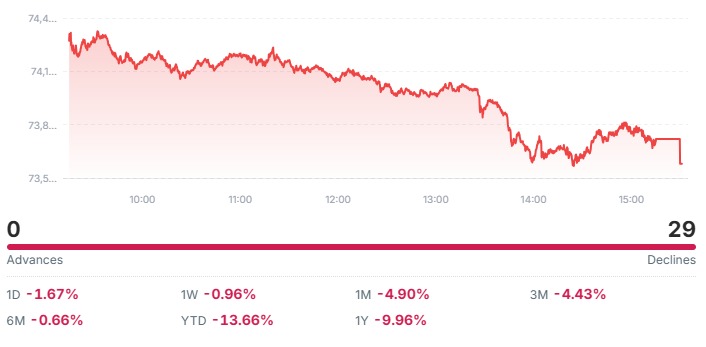
During Wednesday's trading session, the stock touched a high of ₹1,411.30 and a low of ₹1,399.10. Looking at the yearly picture, the 52-week high stands at ₹1,789 (hit on July 21, 2026) and the 52-week low at ₹773.50 (from September 9, 2025). In other words, the stock is still well below its peak — so reading too much into one day's modest bounce would be premature. The company's market cap currently stands at around ₹1.72 lakh crore.
Another thing that's been making headlines lately — foreign investor GQG Partners has been steadily trimming its stake in this stock. Their holding stood at 4.14% at the end of the June quarter, and by August 31, 2026, it had dropped to 3.46%. This marks the second straight quarter of selling by GQG — and not just in this company; they've also cut their stakes in Adani Power, Adani Enterprises, Adani Ports, and Adani Green.
The Shareholding Breakdown
Based on the latest available data as of the March 2026 quarter, promoters hold about 72.73% of the company. FIIs hold roughly 12.23%, DIIs hold about 10.25%, while the remaining ~4.79% is held by the public.
A high promoter holding is usually seen as a sign of confidence, but the steady selling by a major foreign investor like GQG also suggests that not everyone shares that same level of conviction. So basing an investment decision purely on the shareholding pattern isn't the wisest move.
What to Watch Going Forward
The real question now is how PTSL actually delivers on this 2,500 MW supply commitment. Here's what investors should be keeping an eye on:
- Upcoming quarterly results
- Growth in the transmission-distribution business
- Debt levels and capex
- How strong cash flow generation turns out to be
- Any further changes in FII-DII holdings
The Bottom Line
This deal is good news in its own right — by winning a competitive bidding process and having the contract land in the right place within the group, PTSL has secured a long-term, stable revenue source. That said, the rally in the stock is still fairly modest, and the continued selling by a heavyweight like GQG could also be read as a bit of a caution flag. So rather than reading too much into today's price move, it makes more sense to focus on how the company actually performs and delivers over the next few quarters.
Disclaimer: This article is based on publicly available company information, regulatory filings, and market data. It should not be treated as investment advice. Please consult the company's official disclosures and your own financial advisor before making any investment decisions.