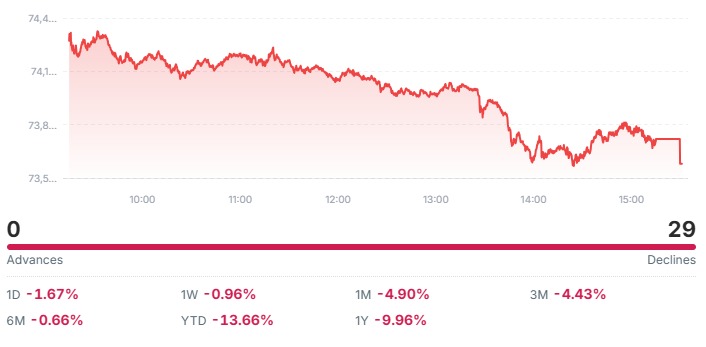

Jaipur, July 31, 2026 — Data Patterns India Limited shares nosedived 8.34% following the release of disappointing Q1FY27 financial results, as the defence and aerospace electronics manufacturer reported a severe sequential decline in performance. Revenue fell 66.35% quarter-on-quarter, net profit collapsed 84.06% QoQ, and earnings per share (EPS) declined 13.41% year-on-year, triggering a significant sell-off and raising concerns among investors about the company's earnings visibility and operational execution.
The sharp earnings miss has refocused market attention on the cyclical nature of defence procurement contracts and the execution risks associated with project-based revenue recognition in the aerospace and defence sector.
Key Metrics Under Pressure
The magnitude of the sequential revenue decline—66.35% QoQ—suggests either a significant gap between Q4FY26 project execution and Q1FY27 order intake, timing lags in contract revenue recognition, or a slower-than-anticipated ramp-up in new programmes. The 84.06% QoQ collapse in net profit, steeper than the revenue decline, indicates that operational leverage worked sharply in reverse, with fixed costs pressing hard against lower sales volumes.
The year-on-year EPS decline of 13.41%, despite a full year of operations, underscores that Q1FY27 performance represents genuine weakening of the company's earnings trajectory, not merely seasonal volatility. For a company in the defence electronics space—where investor confidence hinges heavily on order pipeline visibility and margin predictability—such metrics trigger immediate reassessment of near-term growth prospects.
Defence Electronics Sector Context
Data Patterns operates within India's defence and aerospace electronics ecosystem, supplying critical components and systems for military platforms, satellites, and airborne applications. The sector has traditionally benefited from: (i) rising defence budgets across India and allied nations, (ii) India's push toward indigenisation under the Atmanirbhar Bharat initiative, and (iii) growing participation in global aerospace supply chains.
However, defence procurement remains episodic. Large contracts execute over multi-year cycles with lumpy revenue patterns. A weak Q1 can reflect the tail-end of one project completing before the next major order ramps up—a timing issue rather than structural demand weakness. Conversely, it can signal project delays, customer budget constraints, or geopolitical headwinds affecting defence spending timelines.
Investors must distinguish between temporary order timing gaps and deterioration in the underlying order book. The market's 8.34% reaction suggests concern that Q1FY27 weakness reflects the latter—a material slowdown in order intake or delays in project milestones.
Margin Pressure and Operational Efficiency
The disproportionate 84% decline in net profit relative to a 66% revenue drop indicates that Data Patterns' cost structure came under significant pressure in Q1FY27. Fixed costs (R&D, manufacturing overhead, administrative salaries) did not scale with the revenue contraction, suggesting either:
- A temporary trough in revenue while fixed costs remain sticky, with profit recovery expected as volumes normalize
- Structural margin compression if competitive pricing or project mix deterioration has eroded unit economics
- One-time charges or provisions affecting reported profitability
Without detailed segment and cost-of-goods-sold breakdown, investors should seek clarification from management regarding the sustainability of margins in the quarters ahead. A 66% revenue drop followed by strong recovery is manageable if gross margins hold. Sustained margin compression signals deeper concern.
Investor Concerns and Path Forward
The sharp sell-off reflects several overlapping concerns:
-
Order Pipeline Visibility – Defence contracts are lumpy; weak Q1 raises questions about Q2-Q4 execution and whether new project orders are coming in to offset seasonal troughs.
-
Execution Risk – In aerospace and defence, delays in programme milestones are common but costly. If Data Patterns has faced delays in key customer programmes, it could impact Q1-Q3 revenue recognition.
-
Customer Concentration – If the company depends heavily on a few large government or OEM customers, delays in their procurement cycles directly impact Data Patterns' top line.
-
Margin Recovery – Investors need confidence that profitability rebounds as revenue normalizes. If margins remain compressed at higher revenue levels, the company is in structural trouble.
Aurelius Business View
Defence Capex Cycles and the Perils of Earnings Predictability
Data Patterns' Q1FY27 miss illustrates a hard truth for investors in defence and aerospace supply chains: revenue visibility in this sector is constrained. Unlike consumer electronics or IT services, where quarterly growth trends are relatively predictable, defence electronics operates in a procurement environment shaped by:
- Government budget cycles and fiscal year-end spending patterns
- Multi-year contract phasing and payment schedules
- Geopolitical events that accelerate or defer defence spending
- OEM programme delays cascading through the supply chain
The 8.34% sell-off may be an overreaction if Q1FY27 represents a valley between two major project cycles. But it may also be justified if the slowdown reflects weakening order intake or customer delays signalling softer demand ahead.
What investors should monitor:
- Management commentary on order backlog – A strong, visible order book for FY27 would suggest Q1 is a timing anomaly, not a trend.
- Q1 guidance revision – If management cuts full-year guidance materially, it signals structural weakness.
- Margin trajectory – Watch Q2 results closely. If revenue stabilizes but margins remain compressed, there's a problem.
- Customer updates – Any news on delays to key programmes (e.g., indigenous fighter jets, satellite platforms, helicopter upgrades) could explain Q1 weakness.
For now, Data Patterns shares offer a "show me" moment. The company must demonstrate either (a) a strong order pipeline offsetting Q1's weakness, or (b) a credible path to margin recovery as volumes normalise. Until then, the 8.34% decline may find support among long-term holders, but new buying will remain cautious. Defence stocks demand conviction; Q1FY27 results have shaken it.
Investment Disclaimer:This article is for informational purposes only and should not be construed as investment advice. Aurelius Business does not recommend buying, selling, or holding securities of any company mentioned. Stock market investments carry risk of loss. Readers should consult a qualified financial advisor before making any investment decision. Past performance is not indicative of future results. The information herein is based on publicly available data and is believed to be accurate at the time of publication but is subject to change without notice.