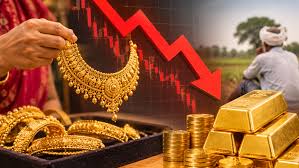
India's Gold Demand Falls 29% in Q3 2026 as High Prices Hit Buyers; Gold ETF Demand Recovers
India's gold demand witnessed a significant decline in the September quarter as record-high prices affected consumer purchasing decisions. According to the World Gold Council (WGC), India's total gold demand fell 29% year-on-year to 162.5 tonnes in Q3 2026 (July-September), compared with the same period last year.
However, on a quarterly basis, demand increased 24% from 130.9 tonnes in Q2 2026. Despite lower buying volumes, the total value of gold demand increased 3% year-on-year to Rs 2.42 lakh crore.
The contrasting trend highlights the impact of rising gold prices. Consumers purchased less gold by weight but spent more money because of higher prices. Many buyers are postponing purchases or opting for lighter jewellery to manage their budgets.
Gold Jewellery Demand Rises 33% Quarter-on-Quarter
Jewellery remains a major component of India's gold consumption. According to WGC data, jewellery demand increased 33% quarter-on-quarter to 99.9 tonnes in Q3 2026. However, it was still 20% lower than the 125 tonnes recorded in Q3 2025.
The quarterly recovery was supported by festive buying and the beginning of the wedding season. Festivals such as Diwali and Dhanteras traditionally encourage gold purchases in India.
However, elevated prices have changed consumer behaviour. Buyers are increasingly choosing lightweight jewellery, smaller designs and lower-carat products instead of heavy gold ornaments.
In value terms, jewellery demand increased 16% year-on-year to approximately Rs 1.49 lakh crore, reflecting the impact of higher gold prices.
Investment Demand Remains Below Last Year's Levels
Investment demand also remained weak compared with the previous year's exceptionally strong performance.
Demand for gold bars and coins increased 9% quarter-on-quarter to 55 tonnes. However, it declined 40% year-on-year from 91.6 tonnes in Q3 2025.
This suggests that investors are becoming more cautious about purchasing physical gold at elevated prices.
Gold ETFs witnessed a mixed trend. Demand increased from 3.6 tonnes in Q2 2026 to 5.3 tonnes in Q3. However, it remained 50% lower than the 10.7 tonnes recorded in the corresponding quarter last year.
Digital gold purchases were estimated at 4.9 tonnes during the quarter, compared with 3.4 tonnes a year earlier.
These trends indicate that investors continue to explore different ways of investing in gold, although overall investment demand remains below last year's levels.
Gold Imports and Recycling Activity Decline
India is one of the world's largest gold-importing countries. Therefore, changes in domestic demand directly influence bullion imports.
According to the WGC report, India's total gold supply declined 43% year-on-year to approximately 1