Jaipur — Motilal Oswal Financial Services has thrown its weight behind Lenskart Solutions, setting a ₹600 target price on the omnichannel eyewear retailer and arguing that India's underpenetrated optical market leaves ample room for expansion, particularly for an operator as vertically integrated as Lenskart.
The brokerage initiated coverage in February 2026 with a Buy recommendation, viewing Lenskart not as a conventional optical retailer but as a technology-led platform controlled by its own manufacturing footprint. That thesis has gathered momentum following the company's latest quarterly results, which show accelerating revenue growth and sharply rising profitability.
Lenskart reported consolidated revenue of ₹2,714 crore in the first quarter of FY27, up 43% year-on-year, while EBITDA surged 76% to ₹588 crore. Net profit climbed to ₹222 crore from ₹60 crore a year earlier. The performance lifted the stock to ₹627 on the BSE on August 12—roughly 27% above where it traded when Motilal Oswal published its initial report.
The numbers matter because they validate what the brokerage identified as Lenskart's structural advantage: manufacturing discipline. Unlike conventional retailers that rely on third-party suppliers and carry retail markup costs, Lenskart operates centralized production facilities for frames and lenses. Motilal Oswal estimates this model delivers costs 35–40% lower than sourcing from external vendors, a margin advantage that compounds across scale.
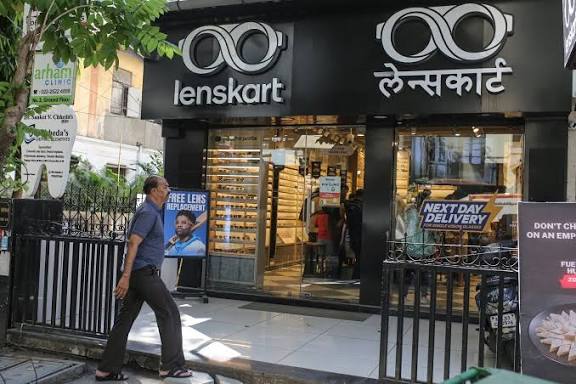
That advantage is getting wider. The company is building a new facility in Hyderabad to expand capacity ahead of aggressive store expansion. Lenskart already operates roughly 2,439 outlets across 435 Indian cities, plus about 705 international stores, mostly in Japan and Southeast Asia. Motilal Oswal identifies more than 4,200 potential new store locations in India alone, with its base case assuming 1,480 net additions between FY25 and FY28.
The unit economics are compelling. Stores function primarily as testing and experience centers, with 75% of inventory managed centrally through just-in-time logistics. Average store payback is around 10 months at pre-Ind AS EBITDA margins of roughly 33%—a profile that justifies rapid rollout as long as capital discipline holds.
The margin story is the real driver
Motilal Oswal's confidence rests less on revenue growth than on profitability expansion. The brokerage forecasts consolidated pro forma revenue growing at 25% CAGR through FY28, but expects pre-Ind AS EBITDA to nearly double the pace at 53% CAGR. That 625 basis points of margin expansion reflects the operating leverage that comes with scaling a manufacturing-backed retail network—higher volumes, better product mix and fixed-cost absorption.
But that math depends on two things holding: continued store productivity gains and sustained pricing power. Lenskart's current market share sits around 5% of India's eyewear market, where only 35% of prescription demand is currently met by organized players. Growth opportunity is real. Valuation risk, however, is equally real. A stock at a premium needs to keep delivering. Any stumble in store additions, margin trajectory or international traction could unwind investor expectations faster than management can reset guidance.
Aurelius business view
The August results support Motilal Oswal's thesis, but only on the near-term numbers. What remains unproven is whether Lenskart can keep opening 370+ stores a year while maintaining store economics and whether margins truly expand by 625 basis points over three years. Competitive pressure is rising—Amazon and other platforms are testing optical categories, and regional players are consolidating. For swing traders, the recent 7% run to ₹627 on results day suggests short-term momentum has lifted the stock near its broker target. Position traders should watch for sustained EBITDA growth above 40% to justify further multiple expansion beyond current levels. Longer-term investors need to see whether international operations can justify the premium valuation being assigned to the core India business.
Disclaimer: This article is for informational purposes only. Target prices mentioned are those of Motilal Oswal Financial Services and do not represent investment advice from Aurelius Business. Investors should conduct independent research and consult a SEBI-registered investment adviser before making investment decisions.