
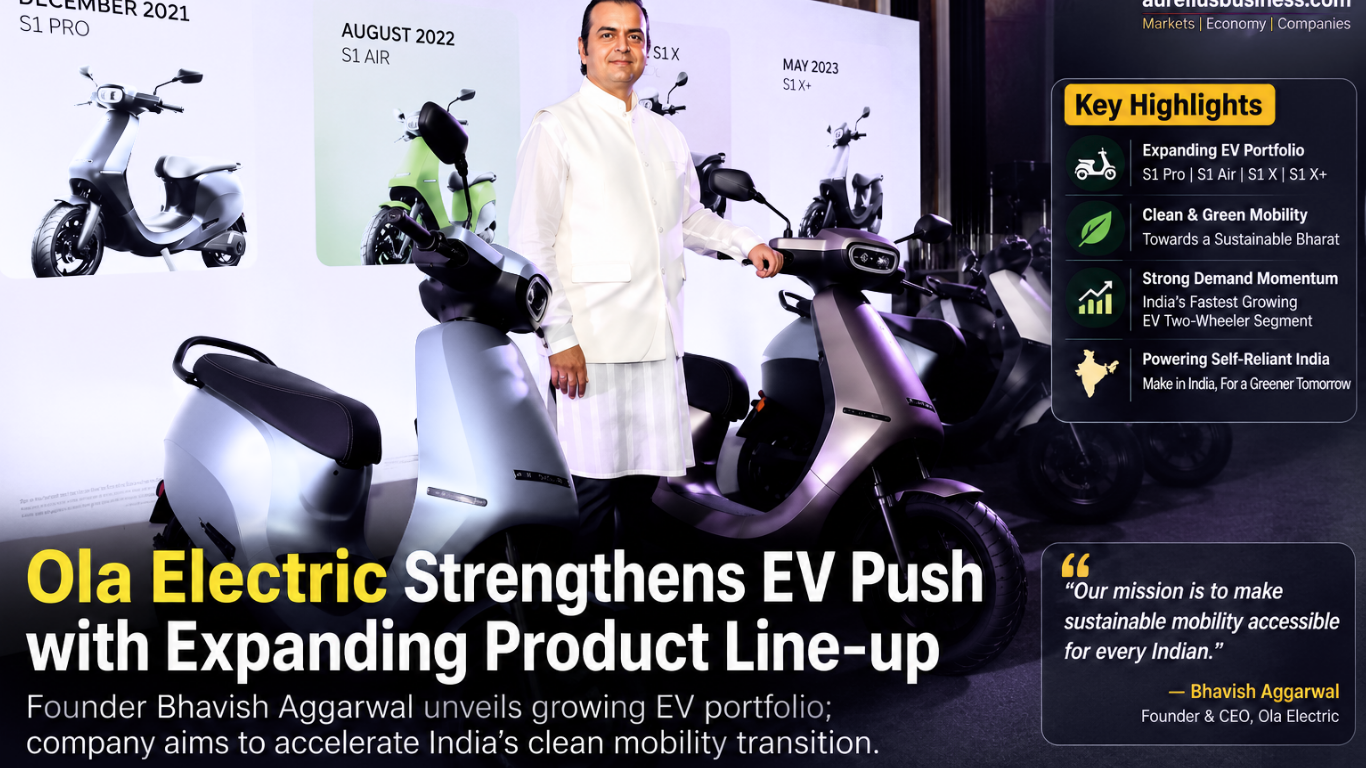
Jaipur: Ola Electric Mobility shares have crashed nearly 75% from their all-time high of ₹157.53 touched shortly after listing, making it one of the steepest declines among India's recently listed companies. With the stock now trading in the ₹37-38 range, the electric two-wheeler maker's Q1 FY27 earnings — due in the coming days as part of the July-August results season — have taken on outsized importance for investors trying to decide whether the worst is over.
The upcoming numbers will be scrutinised not just for the headline loss figure, but for whether the operational improvements management has been talking about for two quarters are finally translating into a genuine volume recovery.
A Rough FY26 Behind the Stock's Fall
The scale of the decline traces back to a difficult FY26. Management had guided for annual deliveries of 3.25-3.75 lakh vehicles at the start of the year, banking on festive demand, the Gen 3 scooter launch and its motorcycle rollout. Instead, deliveries came in at just 1,73,794 units for the full year, down sharply from 3,07,846 units in FY25, and consolidated revenue nearly halved to ₹2,253 crore from ₹4,514 crore.
Quarter by quarter, the top line kept shrinking — from ₹828 crore in Q1 FY26 to ₹690 crore in Q2, ₹470 crore in Q3 and just ₹265 crore by Q4. The full-year net loss widened to ₹1,833 crore, with negative operating cash flow of ₹775 crore and free cash flow of -₹1,492 crore.
The Other Side of the Story: Margins Kept Improving
What makes the setup for Q1 FY27 interesting is that even as sales volumes fell through FY26, Ola's unit economics moved in the opposite direction. Gross margin climbed steadily from 25.8% in Q1 to 30.9% in Q2, 34.3% in Q3 and 38.5% in Q4 — driven by deeper vertical integration, a maturing Gen 3 platform and tighter cost control across manufacturing and retail.
Q4 also delivered the company's first quarter of positive consolidated operating cash flow, at ₹91 crore, aided by production-linked incentive receipts and better working-capital management. The auto business alone generated ₹213 crore of operating cash flow. Even so, the adjusted operating EBITDA loss for the quarter stood at ₹326 crore and the net loss remained elevated at ₹500 crore — a reminder that better margins on fewer vehicles sold could only do so much.
Has the Service Problem Actually Been Fixed?
Service failures — long repair waiting times and spare-parts shortages — were widely blamed for denting demand and brand trust through FY26. The company says it has made real progress here: average service turnaround time reportedly fell from around nine days in October 2025 to close to one day by March 2026, service backlog dropped from 14 days to six, and same-day repair rates rose to roughly 87%. Warranty costs also fell sharply, from ₹555 crore in FY25 to ₹59 crore in FY26, which the company attributes to the improved reliability of Gen 3 vehicles.
Early signs of demand response followed — April 2026 registrations rose 20% month-on-month even as the broader electric two-wheeler industry contracted. Whether that momentum held through May and June, inside the Q1 FY27 window, is one of the central questions this earnings print needs to answer.
What the Street Wants to See From Q1 FY27
Management has guided for consolidated revenue of ₹500-550 crore for the quarter and order volumes of 40,000-45,000 vehicles — nearly double the Q4 level. That would mark a meaningful sequential improvement, but investors will be watching the gap between orders (bookings), registrations (retail sales) and deliveries (revenue-recognised sales), since a strong order book only matters if it converts into billed vehicles within the quarter.
Company estimates suggest adjusted operating EBITDA breakeven requires monthly volumes of 20,000-25,000 units, translating to roughly 60,000-75,000 vehicles a quarter — meaning even the upper end of Q1 guidance would still fall short of breakeven. Gross margins are also expected to soften slightly this quarter and next, as commodity costs rise and the company uses pricing to support volume growth; a modest margin dip would not be alarming on its own if it comes with stronger unit sales.
Motorcycles and Batteries: The Next Growth Levers
Beyond scooters, the Roadster motorcycle range contributed close to 15% of April's gross orders, with the company claiming over half of India's electric motorcycle market. Given that India's motorcycle segment dwarfs the scooter segment and EV penetration there remains low, this could become a meaningful second growth engine if production capacity — which management has flagged as the real constraint, not demand — keeps scaling up.
On the battery side, Ola has commissioned 2.5 GWh of cell capacity with plans to scale toward 6 GWh, and roughly 15% of current orders already use its in-house Bharat Cells, with a full portfolio shift targeted by September 2026. The energy-storage business (Shakti platform) has been slower to ramp than earlier guided, since cell output has so far been prioritised for the vehicle business — a thread worth watching in the Q1 commentary.
Aurelius Business View
Ola Electric's Q1 FY27 results arrive at a genuine inflection point for the stock, not just another routine earnings print. The market has already priced in a great deal of pessimism — a nearly 75% drawdown reflects that. But the bar for a re-rating isn't simply "losses narrow"; it is whether volume recovery, margin discipline and cash generation can all move together, rather than one improving at the expense of another, as happened repeatedly through FY26.
We would treat management's revenue and order guidance as the floor to judge the print against, not the ceiling. A quarter where deliveries meaningfully exceed Q4's dismal 20,256 units, gross margins hold above 33-35% even with some softening, and operating losses narrow on a genuinely improving cost base would be a credible first step toward rebuilding confidence. Conversely, if order growth doesn't convert into billed deliveries, or if cash burn reaccelerates even as revenue improves, the stock's recent bounce off its lows could prove short-lived. Given the stock's history of guidance misses in FY26, investors would do well to judge Ola Electric on delivered numbers this quarter rather than on fresh full-year promises.
Investment Disclaimer: This article is for informational purposes only and should not be construed as investment advice. Stock market investments are subject to market risks. Readers are advised to consult a certified financial advisor before making any investment decisions. Aurelius Business does not take responsibility for any financial losses incurred based on the information provided in this article.