Earthquake in China’s Car Market: September Sales Fall 24%, Now the Government Will Ban ‘Hidden Door Handles’ and Touchscreen-Only Essential Controls
The world’s largest car market is currently facing a double blow. On one side, customers in showrooms have decreased, and on the other, the government has raised questions about the very design of cars. In September 2026, passenger vehicle sales in China fell sharply. At the same time, the country’s industry ministry has released a draft of rules that could end many features that have become the identity of modern cars. The entire auto industry has its eyes on this news.
What Do the Numbers Say?
According to the latest data from the China Passenger Car Association (CPCA), retail sales of passenger vehicles in China fell 24% in September 2026 compared to last year. In the whole month, only 1.702 million (17.02 lakh) vehicles were sold.
The most shocking news has come from the New Energy Vehicle (NEV) segment, that is, electric and hybrid vehicles. Until now, this very segment was considered the growth engine of the Chinese market, but its sales have also declined by 12% on an annual basis. Even so, the picture is not completely bleak. NEVs still hold a 67.1% share of total car sales. That means that out of every three vehicles, more than two sold are electric or hybrid. The decline is in the size of the market; there has been no change in customers’ preferences.
Three Big Reasons Behind the Fall in Sales
Auto experts mainly cite three reasons for this slowdown.
First, weak domestic demand. In an atmosphere of economic uncertainty, the ordinary Chinese consumer is postponing big purchases. An expensive item like a car has slipped down his priority list.
Second, the high base effect. In the same period last year, that is, 2025, record car sales were made on the strength of government subsidies. When the previous base is that high, even this year’s normal figures look like a decline. A big part of the 24% fall is the result of this very comparison.
Third, disillusionment with petrol-diesel cars. Customers have now almost rejected vehicles running on traditional fuel. The biggest loss from this is being suffered by those old car companies whose business still rests on these vehicles. Their sales are going down rapidly.
The Government’s Tough Stance: Why Did the New Draft Come?
Amid this sales crisis, China’s Ministry of Industry and Information Technology (MIIT) has released a tough draft of rules regarding car safety. The government’s concern is that companies are giving new features to lure customers, but these are not being tested adequately. As a result, many features, instead of giving convenience, are becoming a danger to life.
The main points of the proposed rules are:
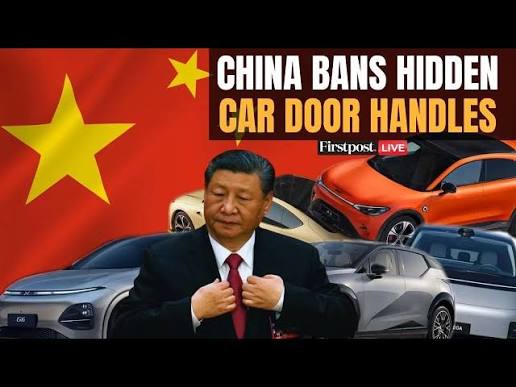
- Ban on fully hidden handles: A ban is proposed on electronic (pop-up) handles that hide inside the door. In the event of an accident, these handles often jam, and the lives of people trapped inside are put at risk.
- Physical buttons mandatory: For safety-related essential functions such as wipers, headlights, and defoggers, touchscreens or virtual controls will not be valid. Companies will have to provide real buttons that can be pressed by touch.
- Restriction on foldable screens: The use of bendable or flexible displays inside the car will be prohibited.
- 30,000 km testing: To get approval, any car with a new design will have to go through at least 30,000 kilometres of on-road testing.
Automakers do not have much time to prepare. They will have to adapt their vehicles to these rules before the deadline of January 1, 2027.
What Will Change Ahead?
China is the world’s largest car market, so the decisions made there do not remain limited to China. Their far-reaching effects may fall on the industry across the world, including India.
1. The end of the ‘smartphone on wheels’ era. In the last few years, there was a race among companies to remove as many buttons as possible from the car’s interior and install one big screen, the more the better. Now a brake seems to be coming on this thinking. The respectable return of buttons and knobs in interiors is considered certain.
2. Safer driving. Compared to searching for a menu in a touchscreen while driving, pressing a button is much easier. It does not require taking your eyes off the road. When distraction reduces, a reduction in accidents is also expected.
3. Impact on India and the global market. Experts believe that seeing these strict standards of China, agencies like Euro NCAP and safety regulators in America and Europe may also impose similar strictness on touchscreens in the future. If this happens, its effect will be seen on the design of cars sold in India as well.
4. Cars may become expensive. The cost of redesign and the additional 30,000 km of testing will increase companies’ costs. This burden could fall especially heavy on new EV startups, and there is a fear that it will be recovered by raising car prices.
Conclusion
China’s car market is currently standing at a turning point. The sharp fall in sales shows that the momentum gained on the support of subsidies has now stopped, and customers are spending money thoughtfully. On the other hand, the government’s message is clear: the cars of the future will not be just fancy-looking; passenger safety will come first in them.
It should be kept in mind that MIIT’s rules are still in draft form. Changes in the final form are possible. But the direction is clear, and before the deadline of January 1, 2027, changing designs will be a big challenge for automakers. It remains to be seen how, under this pressure, companies manage both the fall in sales and the new safety standards together.
Sources: China Passenger Car Association (CPCA) September 2026 data; draft rule proposal of China’s Ministry of Industry and Information Technology (MIIT).