
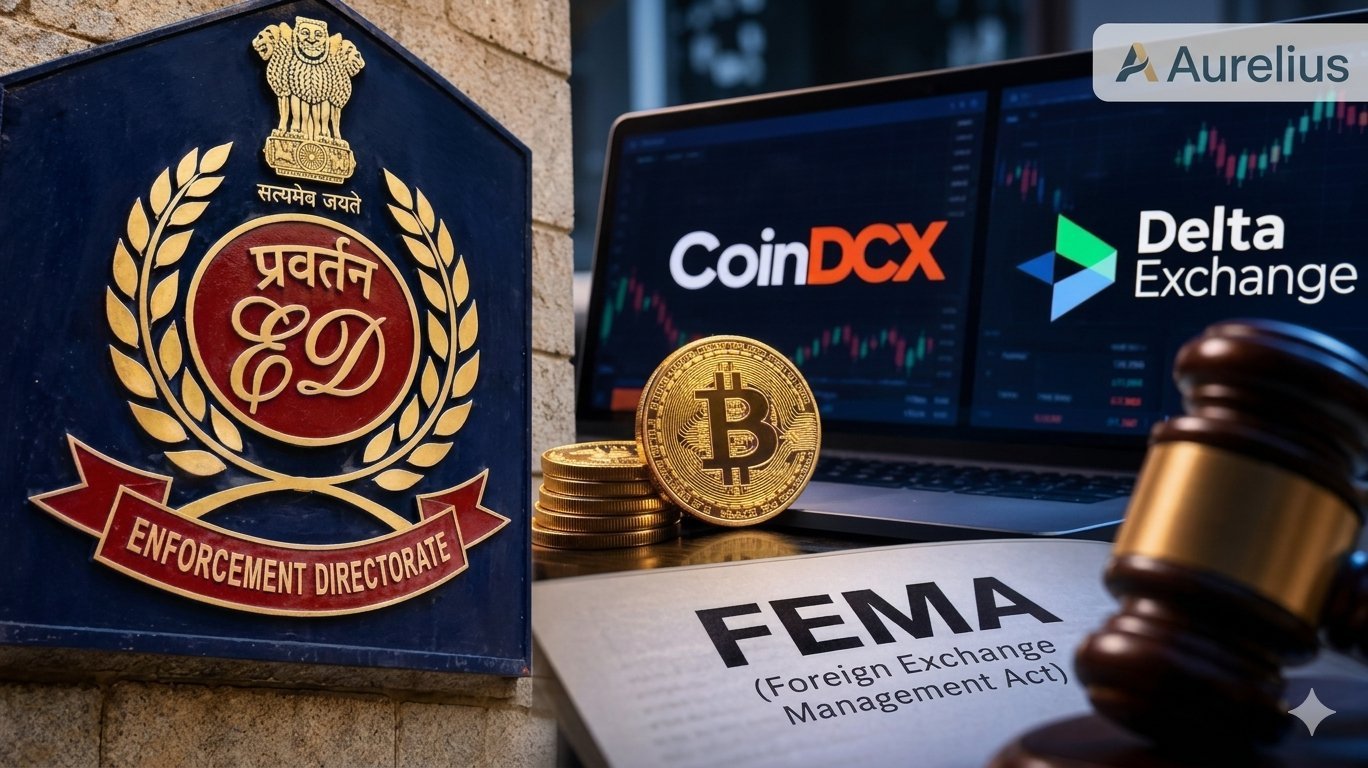
ED Cracks Down on Crypto Exchanges: CoinDCX and Delta Exchange Under Investigation Over Futures and Tokenised US Stocks
Regulatory scrutiny of India's crypto and fintech sector appears to be intensifying. The Enforcement Directorate (ED) has taken major action against some of the country's leading crypto and derivatives platforms (CoinDCX, Delta Exchange, Mudrex and Saber Money), launching investigations and conducting raids over alleged violations of the Foreign Exchange Management Act (FEMA), 1999. The agency alleges that these platforms carried out unauthorised cross-border financial transactions worth thousands of crores of rupees through stablecoins.
What Is the Whole Case?
On November 4 and 5, the ED began investigations at the premises of Neblio Technologies, the operator of CoinDCX, and Axelium Technologies, the operator of Delta Exchange. The agency's action focuses mainly on two services: crypto futures and options (F&O), and trading in tokenised shares (Tokenised US Stocks) of major American companies such as Apple, Google and Tesla.
The allegation is that investments made by Indian users in rupees (INR) were converted into stablecoins (USDT) and sent, via the accounts of a shell company in Costa Rica, to foreign exchanges such as Binance, KuCoin, Gate.io and Hyperliquid. Delta Exchange is also alleged to have routed a large share of its derivatives transactions through CoinDCX.
Earlier, at the end of October, the ED also raided RPFAS Technologies, the operator of Mudrex and Saber Money. The investigation has found preliminary evidence of money being sent abroad via stablecoins without RBI approval, the use of shell companies in Canada and the US, and unauthorised crypto balances of more than ₹4,600 crore on foreign platforms. According to the ED, these products also prima facie violate SEBI and RBI rules.
What Is Section 37 of FEMA?
The investigations were conducted under Section 37 of FEMA. Under this provision, ED officers are given special powers similar to those of Income Tax officers, subject to the applicable statutory restrictions.
However, Section 37 does not grant unlimited powers of search and seizure. This is why users' funds held on the exchanges have not been immediately blocked. The exact powers available, along with the safeguards and limits governing their use, depend on the relevant statutory provisions and the circumstances of each case.
Read also this-India Gold Demand Falls 29% in Q3 2026 to 162.5 Tones: WGC Report
Is Investors' Money Safe?
This is the biggest question for users right now, and the honest answer has two sides.
- All four platforms under investigation say users' money is safe.
- Delta Exchange says trading, deposits and withdrawals are functioning normally and that user funds are held in Indian banks.
- Section 37 does not allow the ED to immediately freeze users' funds, and no such blanket freeze has been reported.
- The ED's allegations concern how funds were routed across borders, and they have not yet been proven. The platforms deny wrongdoing and say they are cooperating.
What remains uncertain:
- The investigation is ongoing, and the ED could take further steps under other legal provisions as it examines the money trail.
- Crypto exchanges in India have no deposit insurance or government-backed investor protection scheme, unlike bank deposits or SEBI-regulated securities.
- Funds that were allegedly routed to overseas exchanges raise questions about where user assets actually sit. The companies' assurances are statements, not independent audits.
- If the platforms face penalties, restrictions or operational disruption, users could be affected indirectly, for example through delayed withdrawals.
What users can do:
- Check whether your platform publishes proof-of-reserves or audit reports.
- Avoid keeping more money on any exchange than you actively need for trading.
- Make sure you can withdraw your funds, and keep records of your deposits, trades and withdrawals.
- Follow official updates from the platforms, the ED, the RBI and SEBI.
This article is for information only and is not investment or legal advice.
What Do the Companies Say?
- CoinDCX described it as a routine inquiry, saying it is registered with FIU-IND, complies with all Indian laws and KYC/AML rules, and is fully cooperating with the investigation.
- Delta Exchange issued a statement saying its operations are completely normal and users' money is safe in Indian banks.
- Mudrex also reiterated full compliance with the rules and assured authorities of all possible cooperation.
What Next?
For now, the ED has traced the wallet movements and the legal framework of the transactions. The entire fintech industry is now watching whether the Reserve Bank of India (RBI) and the market regulator SEBI will separately take any strict steps against these crypto products and payment arrangements.
Read this-India’s GDP Growth May Beat RBI’s 6.7% Forecast: Poonam Gupta Says 7.5% Growth Is Achievable
Stay Connected with Aurelius and Stay Updated!
To be the first to know every major story from the world of business, fintech and finance, along with precise analysis and shifting market trends, stay connected with Aurelius. Make your investment and business decisions with accurate and trustworthy information.
For more information and the latest updates, visit our website today at [insert your website link here] or follow our social media handles.